
Imagine it is a Tuesday morning in the year 2026. You wake up, grab a coffee or tea, and instead of commuting for an hour through heavy traffic, you walk ten steps to your desk. You put on a lightweight headset or open a sleek laptop, and suddenly, you are “at work.” But work doesn’t look like a boring cubicle anymore. It looks like a digital playground where collaboration is instant, and geographical borders don’t exist.
Remote work is no longer just a “trend” or a backup plan; it has become the standard for millions of people around the globe. By 2026, the tools we use to get things done have evolved from simple chat apps into sophisticated ecosystems powered by Artificial Intelligence (AI) and Augmented Reality (AR).
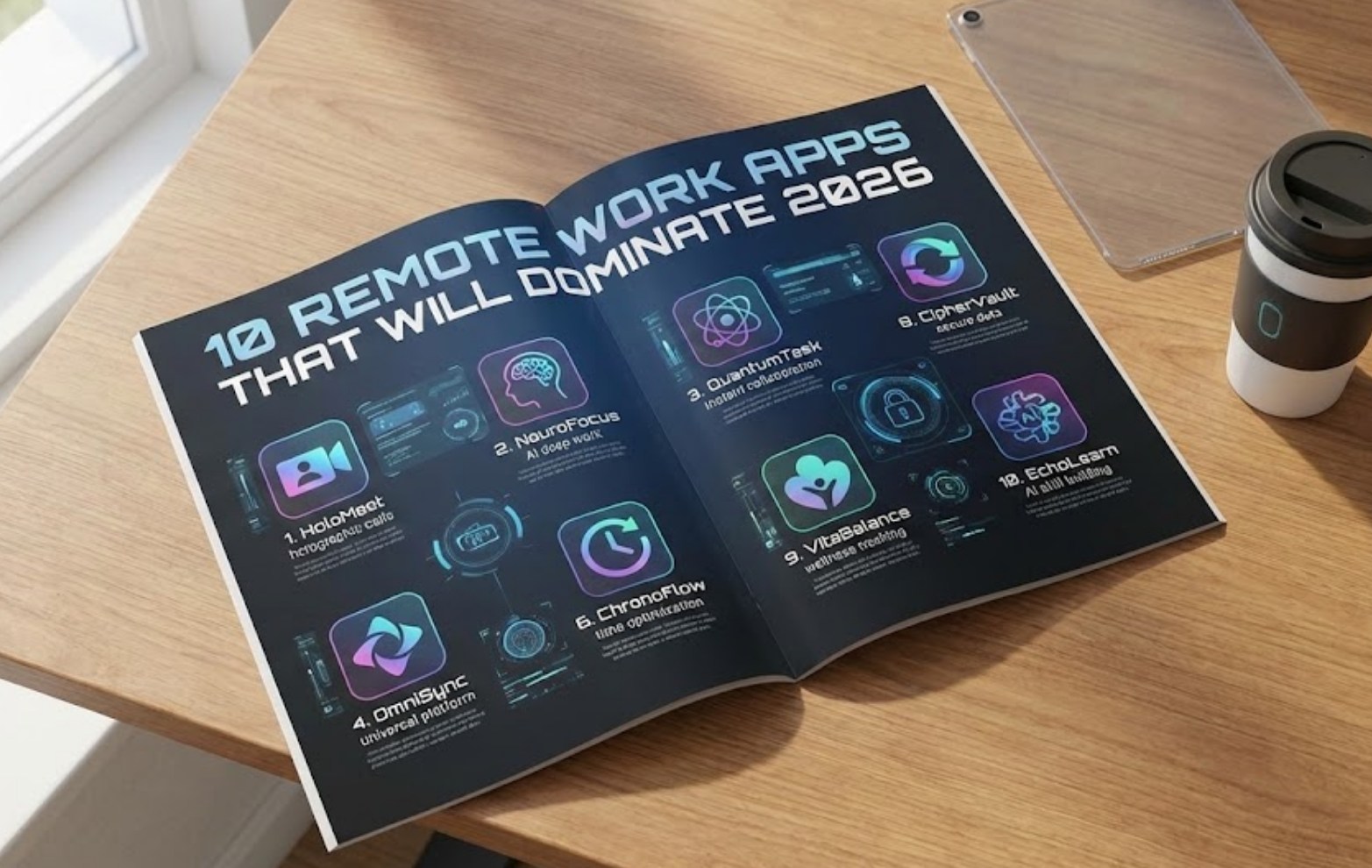
If you are curious about what the professional world will look like in just a couple of years, here are the 10 apps that are set to dominate the remote work landscape.
1. Gather: The Virtual Office Game
Think of Gather as a mix between a professional office and a high-definition video game like Stardew Valley or Pokémon. Instead of staring at a flat grid of faces on a video call, you have a digital avatar that walks around a virtual office.
-
- Spatial Audio: When your avatar walks close to a coworker’s avatar, their video and audio automatically turn on.
- Spontaneous Chats: You can “bump into” someone in the virtual hallway to ask a quick question, just like in real life.
- Customization: Teams can build their own offices, adding fountains, breakrooms, and even digital board games.
2. Notion: The Digital Brain
By 2026, Notion has moved far beyond being a simple note-taking app. It has become the “central nervous system” for companies. It uses advanced AI to organize every document, project, and meeting note a company has ever produced. If you need to find a project from three years ago, you don’t search through folders; you just ask the Notion AI, and it writes a summary for you.
3. Linear: The Speed King of Projects
For teams building software or managing complex tasks, Linear is the gold standard. It is famous for being incredibly fast. In a world where everyone is tired of slow, laggy websites, Linear’s focus on “streamlined” workflows makes it a favorite. It helps teams track what needs to be done without the clutter of older, clunkier project management tools.
4. Miro: The Infinite Whiteboard
Visual learners thrive on Miro. It is a giant, infinite digital canvas where teams can brainstorm together in real-time. By 2026, Miro will likely integrate more heavily with AR, allowing you to “throw” digital sticky notes onto your actual bedroom wall using smart glasses, which then sync back to your teammates’ screens across the world.
5. Otter.ai: The End of Manual Note-Taking
Gone are the days of frantically scribbling notes during a meeting. Otter.ai uses voice recognition to transcribe meetings as they happen.
-
- It identifies different speakers by their voice patterns.
- It highlights key action items automatically.
- It generates a “TL;DR” (Too Long; Didn’t Read) summary immediately after the call ends.
6. Clockwise: The AI Calendar Assistant
One of the hardest parts of remote work is managing your time. Clockwise uses AI to look at everyone’s calendar and automatically move meetings to create “Focus Time.” It understands that humans need long stretches of uninterrupted time to do their best work, so it fights against the habit of having a 15-minute break between every call.
7. Loom: The Video Message Revolution
Sometimes, an email is too short, but a live meeting is too long. Loom allows you to record your screen and your face at the same time. In 2026, rather than scheduling a 30-minute sync, people simply send a 2-minute “Loom.” You can watch it at 2x speed, leave a comment at a specific timestamp, and move on with your day.
8. Meta Horizon Workrooms
As VR headsets become lighter and more affordable, Meta Horizon Workrooms is becoming a staple for creative teams. It allows you to sit at a virtual table with your colleagues. Even if one person is in New York and another is in Tokyo, it feels like you are making eye contact and sharing the same physical space.
9. Slack (with a 2026 Twist)
Slack has been around for a while, but by 2026, it is expected to be almost entirely AI-driven. Imagine coming back from a vacation and instead of reading 500 unread messages, Slack gives you a bulleted list of the five most important things you missed. It acts less like a chat room and more like a personal assistant.
10. Canva: Design for Everyone
In the remote world, how you present your ideas matters. Canva has democratized design. Whether you are making a pitch deck, a social media post, or a video report, Canva’s “Magic Studio” allows people with zero design experience to create professional-level visuals in seconds using AI prompts.
Why This Matters for the Future
The shift toward these apps isn’t just about “cool technology.” It is about solving the biggest problems of remote work: loneliness, “Zoom fatigue,” and disorganized information. By 2026, these tools will make it possible for a person living in a small town to have the same career opportunities as someone living in Silicon Valley.
To succeed in this environment, the most important skill won’t just be knowing how to use one specific app. Instead, it will be digital literacy—the ability to quickly learn new tools and adapt to different ways of communicating. The office of 2026 isn’t a building; it’s a collection of icons on your taskbar that allow you to create, collaborate, and connect with the world.
