
Imagine walking into a store and buying a smart light bulb, only to get home and realize it won’t talk to your smart speaker because they were made by different companies. For years, building a smart home felt like trying to solve a puzzle where the pieces were from five different boxes. You had to check for “Works with Alexa” or “Compatible with Apple HomeKit” labels like you were looking for a secret code.
Thankfully, the tech world finally got tired of this mess. Two names you will see everywhere now are Matter and Thread. While they are often mentioned in the same breath, they do very different things. Understanding the difference is the key to building a home that actually works the way you want it to.
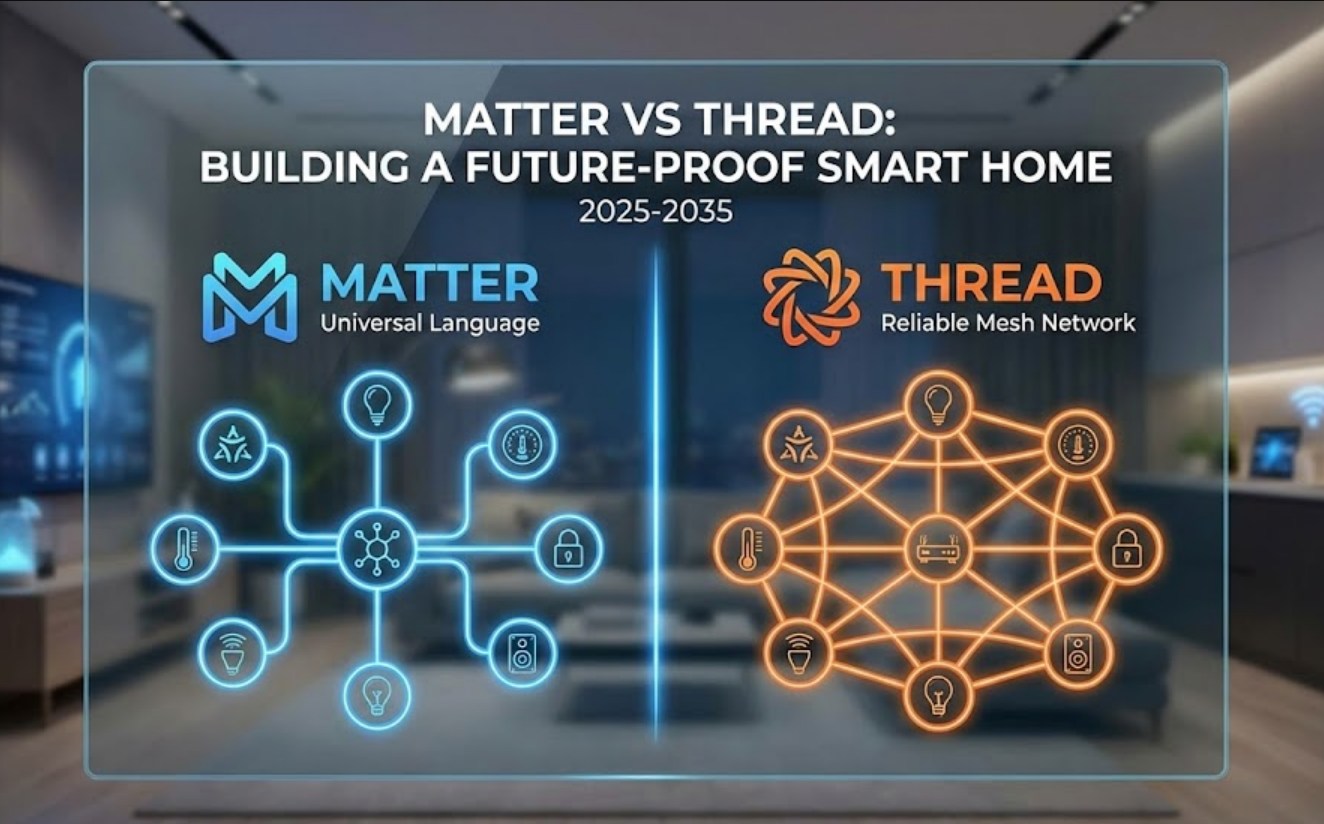
Matter: The Universal Language
Think of Matter as a universal translator. In the past, smart devices spoke different “languages.” A Google Nest hub might speak one language, while an Apple HomePod spoke another. Matter is a new software standard that ensures all smart devices can understand each other, regardless of who manufactured them.
Because big players like Apple, Amazon, Google, and Samsung all sat down and agreed to use Matter, the walls between these ecosystems are finally falling down. Here is why Matter is a big deal:
-
- Mix and Match: You can buy a Samsung smart plug and control it using the Apple Home app on your iPhone or via voice command through an Amazon Echo.
-
- Easier Setup: Matter devices usually come with a QR code. You scan it, and the device connects to your network almost instantly.
-
- Local Control: Instead of sending a command to a “cloud” server thousands of miles away just to turn on a light next to you, Matter allows devices to talk directly to each other over your local home network. This makes things faster and more secure.
Thread: The High-Speed Highway
If Matter is the language being spoken, Thread is the road that the message travels on. Thread is a networking technology designed specifically for smart home gadgets.
Most people are used to Wi-Fi and Bluetooth. Wi-Fi is great for high-power tasks like streaming Netflix, but it uses a lot of energy and can get crowded if you have fifty different devices connected to one router. Bluetooth is low energy but has a very short range. Thread is the “Goldilocks” solution—it’s just right for the smart home.
The most unique thing about Thread is that it creates a mesh network. Here is how that works:
-
- Self-Healing: In a traditional network, if your main router goes down, everything stops. In a Thread mesh network, every “plugged-in” device (like a smart plug or a light switch) acts as a mini-router. If one device fails, the signal simply finds another path to reach its destination.
- No Lag: Because Thread doesn’t rely on a central hub for every single tiny movement, there is almost zero delay. Your lights turn on the moment you tap the screen.
- Battery Efficiency: Thread is incredibly “light.” This means battery-powered devices, like door sensors or thermostats, can last for years on a single charge because they aren’t constantly fighting for a heavy Wi-Fi signal.
How Matter and Thread Work Together
To visualize how these two work together, imagine you are sending a letter to a friend in another country.
-
- Matter is the language the letter is written in (e.g., English). It ensures that when your friend opens the envelope, they can actually read and understand what you wrote.
-
- Thread is the postal service and the delivery truck. It is the physical system that moves the letter from your house to theirs.
You don’t need Thread to use Matter—Matter can also run over Wi-Fi or Ethernet. However, Matter works best when it is running on a Thread network because it makes the whole system faster and more reliable.
Building Your Future-Proof Home
If you are looking to start your own smart home setup, you don’t need to replace everything you own today. Many older devices are getting software updates to support Matter. However, if you are buying new gear, looking for the Matter and Thread logos is the best way to “future-proof” your room.
To get started, you generally need a Thread Border Router. This sounds fancy, but you might already own one. Many newer devices, like the Apple HomePod Mini, the latest Amazon Echo, or certain Google Nest Hubs, have Thread Border Routers built inside them. These devices act as a bridge between your Thread mesh network and your home’s Wi-Fi.
The Bottom Line
The era of worrying about whether a gadget will work with your phone is coming to an end. By using Matter as the common language and Thread as the reliable network, the smart home is becoming what it was always supposed to be: invisible, fast, and helpful.
When you go shopping for tech, remember that Matter is about compatibility (who can talk to whom), and Thread is about connection (how fast and reliably they talk). Together, they ensure that your smart home will stay smart for years to come.
