
It is a typical Tuesday afternoon in 2026. You are halfway through your day, perhaps sitting in a study hall or hanging out after practice, when you glance down at your phone. Your heart sinks. That little green bar has turned a menacing shade of red, and you are sitting at a measly 12%.
How did this happen? You haven’t even been gaming that much today. In 2026, our smartphones are more powerful than the supercomputers of a decade ago, yet we still find ourselves tethered to wall outlets and portable power banks. If you feel like your battery is dying faster than it used to, you aren’t imagining things. Technology has evolved, but that progress comes with a heavy “energy tax.”
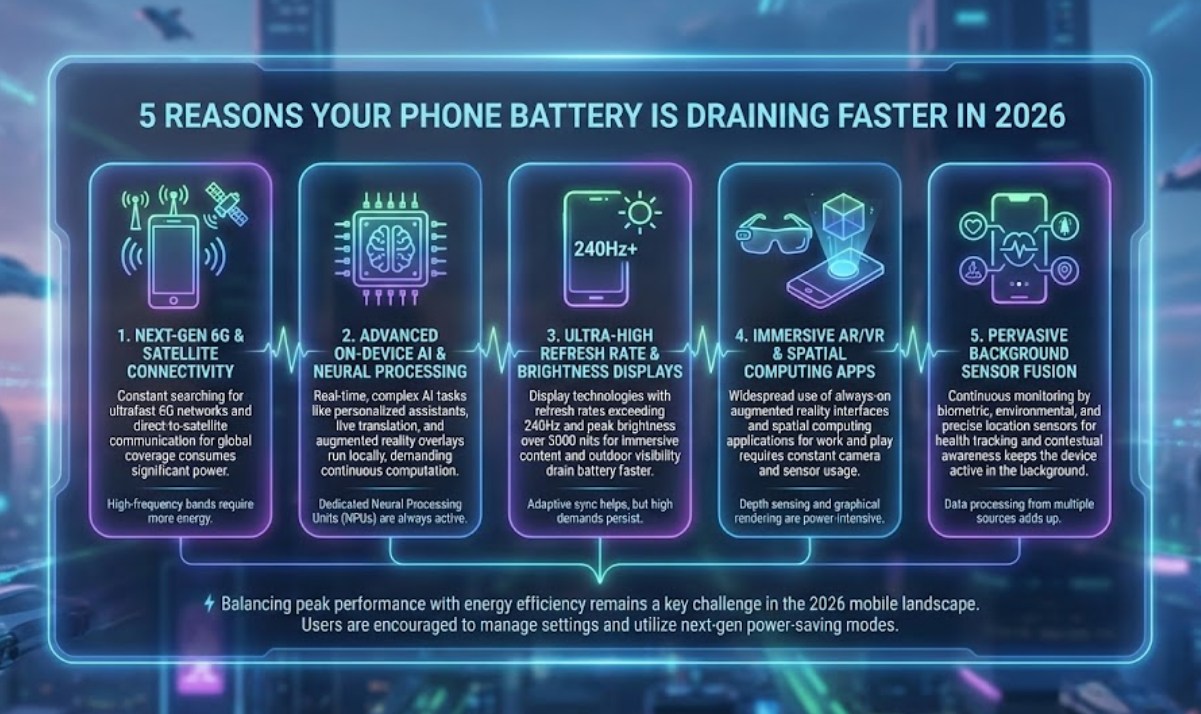
Here are five reasons why your phone battery is struggling to keep up with life in 2026.
1. The 6G Transition and Network Searching
While 5G was the big talk a few years ago, 2026 has brought the early rollout of 6G and even more advanced versions of ultra-wideband 5G. These networks provide blistering speeds, allowing you to download an entire movie in seconds. However, these speeds require your phone to work much harder.
When you are in an area where the signal is “spotty,” your phone doesn’t just give up. Instead, it boosts power to its internal antennae to search for a stronger connection.
-
- Constant Scanning: Your device is constantly pinging towers to stay on the fastest frequency.
- Switching Costs: Every time your phone jumps from a Wi-Fi 7 network to a 6G cellular network, it uses a burst of energy.
- Heat Generation: High-speed data transfers generate heat, and heat is the ultimate enemy of battery efficiency.
2. “Always-On” AI Assistants
In 2026, your phone isn’t just a tool; it’s a personal assistant. Most modern devices now feature integrated AI that runs locally on your phone’s chip rather than in the cloud. This means your phone is constantly “thinking.”
Whether it is your camera automatically identifying objects in real-time, your keyboard predicting your next three sentences, or a voice assistant waiting for a wake-word, your processor never truly sleeps. This background “brain activity” drains the battery slowly but surely throughout the day. Even when the screen is off, the Neural Processing Unit (NPU) inside your phone is often working to organize your photos or update your personalized AI models.
3. High-Refresh-Rate and Ultra-Bright Displays
We all love the look of a modern 2026 flagship phone. The screens are stunning, often featuring 144Hz or even 240Hz refresh rates. This makes scrolling through social media feel buttery smooth. However, the more times a screen refreshes per second, the more power it consumes.
Furthermore, outdoor visibility has become a major selling point. Phones can now reach peak brightness levels that were unheard of a few years ago. If you spend your lunch break outside in the sun, your phone’s “Auto-Brightness” feature likely cranks the screen to its maximum setting.
-
- Hz Demands: Higher refresh rates require the GPU to render frames faster.
- Pixel Density: Pushing 4K resolution on a 6-inch screen takes a lot of juice.
- Haptic Feedback: Those tiny vibrations you feel when you type? They are more advanced now, using sophisticated motors that add to the daily drain.
4. Background App Bloat and Data Syncing
Think about how many apps you have that are constantly “talking” to the internet. In 2026, almost every app uses some form of cloud synchronization. Your fitness tracker is syncing your heart rate, your cloud storage is uploading your latest 8K videos, and your social media apps are pre-loading content so you don’t have to wait for it to buffer.
This constant stream of background data is a silent battery killer. Even if you aren’t actively using an app, it might be running “fetch” cycles every few minutes to check for notifications or updates. Because our apps have become more complex and data-heavy, the energy required to keep them updated in the background has increased significantly.
5. The “Fast Charging” Paradox
In 2026, we have access to incredible 120W or even 200W fast chargers that can take a phone from 0% to 100% in fifteen minutes. While this is incredibly convenient, it comes at a long-term cost to the battery’s health.
Lithium-ion batteries are sensitive to heat and high voltage. The faster you charge a battery, the more heat is generated within the cells. Over months of use, this heat causes the internal chemistry of the battery to degrade.
-
- Capacity Loss: A battery that held 5,000mAh when it was new might only hold 4,200mAh after a year of ultra-fast charging.
- Voltage Stress: Pushing power into the device at high speeds wears down the battery’s “cycle life” faster than slow, steady charging.
How to Fight the Drain
You don’t have to just accept a dead phone by 3 PM. You can take control by making a few small adjustments. Turning off “Always-On Display,” lowering your refresh rate to 60Hz when you don’t need it, and managing which apps have permission to refresh in the background can make a massive difference.
The tech in 2026 is faster and smarter than ever, but it is still limited by the laws of physics. Until the next big breakthrough in battery chemistry arrives, being a smart user is the best way to keep your phone alive until you get back home.
