
If you have ever spent time looking at gaming setups on social media, you know that the keyboard is the heart of the aesthetic. For years, the gold standard has been the mechanical keyboard. We loved them for the “clack,” the RGB lights, and the way they felt under our fingers. But as we move toward 2026, a massive shift is happening. The traditional mechanical switch—the kind with metal springs and pins—is being pushed aside by something faster, smoother, and much smarter: the Magnetic Switch.
To understand why this matters, we first have to look at how keyboards usually work. For decades, when you pressed a key, two pieces of metal touched to complete a circuit. It was simple, but it had limits. Those metal parts eventually wear out, and they can only tell the computer one thing: “Yes, the button is pressed” or “No, it isn’t.” Magnetic switches, often called Hall Effect switches, change that entire conversation.
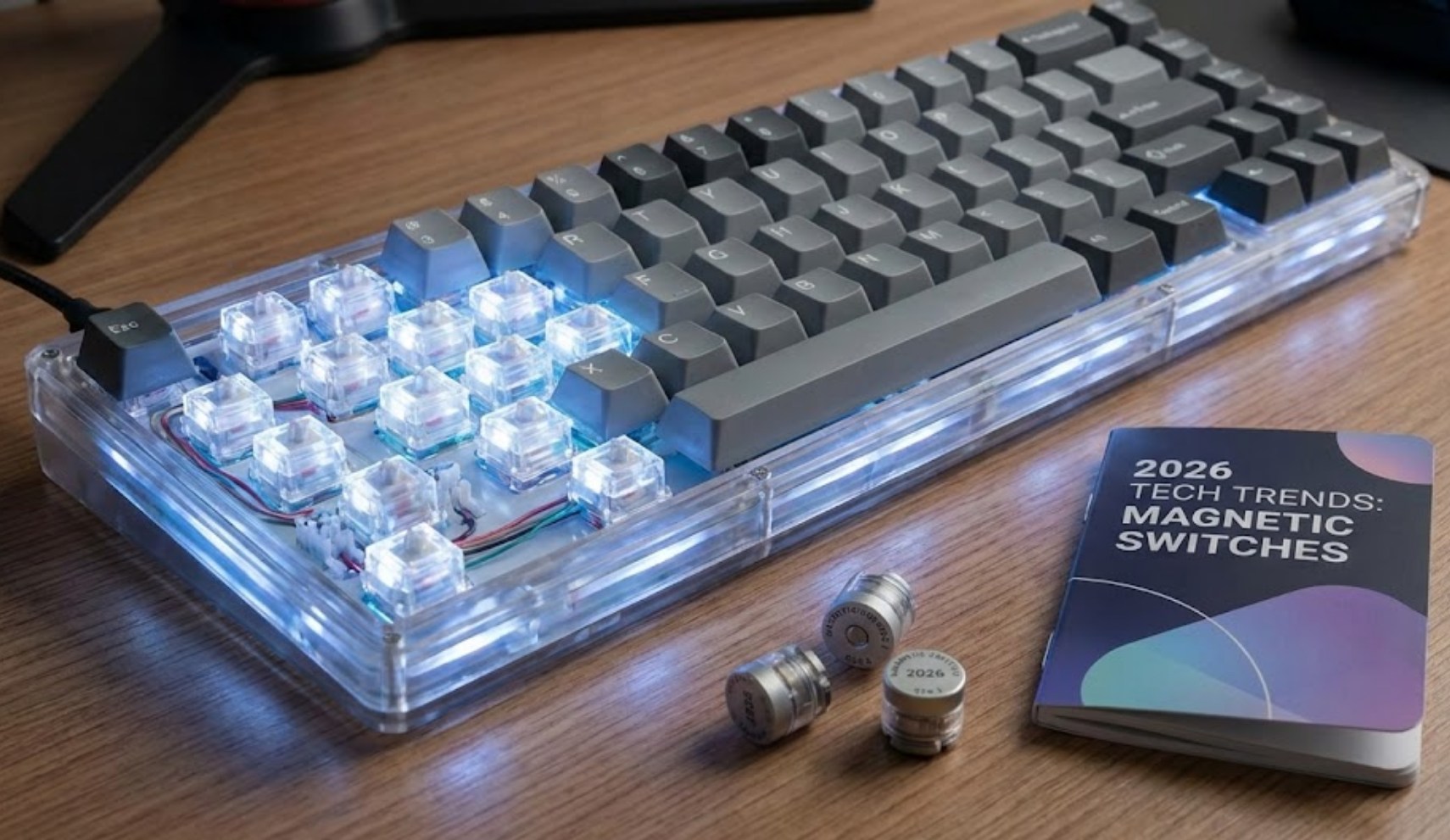
How the Magic Happens
Instead of relying on physical contact, magnetic switches use a tiny magnet inside the key stem and a sensor on the keyboard’s circuit board. As you press the key down, the sensor measures exactly how close the magnet is getting. This might sound like a small detail, but it unlocks features that were impossible just a few years ago.
By 2026, you won’t just be buying a keyboard; you’ll be buying a piece of high-precision hardware that adapts to how you move. Here is why magnetic technology is taking over:
-
- Adjustable Actuation: In the past, if you wanted a “fast” keyboard for gaming, you had to buy specific switches that triggered with a light touch. If you wanted a “heavy” keyboard for typing essays, you had to buy different ones. With magnetic switches, you can change this in the software. You can set your “WASD” keys to trigger the moment you touch them, while setting your “Enter” key to require a deep, firm press to avoid accidental clicks.
- Rapid Trigger Technology: This is the feature that changed everything for competitive gamers. On a regular keyboard, you have to let the key go past a certain “reset point” before you can press it again. Magnetic switches don’t have this physical limit. The keyboard knows the exact millisecond you start lifting your finger, letting you “spam” keys faster than ever before.
- No More Double-Clicking Issues: Since there are no metal leaves touching each other, there is no “debounce” delay. Traditional keyboards have to wait a few milliseconds to make sure the metal didn’t bounce and create a double-press. Magnetic switches are instant and stay accurate for years.
The 2026 Standard: Why Now?
You might wonder why we are talking about 2026. While magnetic switches exist today, they used to be incredibly expensive and hard to find. Only “pro” brands used them. However, the tech is finally becoming affordable. By 2026, we expect even entry-level keyboards to ditch the old metal pins for magnets.
The shift is driven by three main factors:
-
- Durability: Because there is no friction between metal parts, these switches can last for over 100 million presses. This makes them a better investment for anyone who spends hours a day at their desk.
- The Rise of “Snap Tap” and Analog Movement: Games are getting more complex. Magnetic switches allow for “analog” input. This means your keyboard can act like a controller. If you press the “W” key a little bit, your character walks; if you mash it down, they run.
- Customization: The hobby of building keyboards has exploded. People love changing their keycaps and cases. Magnetic switches are now becoming “hot-swappable,” meaning you can pop them in and out without a soldering iron, making it easier for anyone to build their dream deck.
Typing vs. Gaming
One of the biggest concerns people had early on was whether magnetic switches would feel “mushy” for typing. If you are writing a 1,000-word history report, you want a keyboard that feels satisfying. Luckily, engineers have figured this out. By 2026, the magnets are being paired with high-quality polycarbonate and “pom” materials that mimic that crisp, tactile feel we love, while keeping the speed of a magnetic sensor.
You get the best of both worlds: a keyboard that is a silent, professional tool during the day and a lightning-fast gaming weapon at night.
Conclusion: Is It Worth the Hype?
As we look toward the tech landscape of 2026, it is clear that the “clicky” era is evolving. Mechanical keyboards aren’t dying, but they are getting a massive brain transplant. The precision offered by magnetic sensors makes the old way of doing things feel like using a typewriter in a world of touchscreen tablets.
If you are looking to upgrade your setup soon, keep an eye on the “Hall Effect.” It isn’t just a gimmick for pro gamers anymore; it is the new standard for anyone who wants a keyboard that lasts longer, reacts faster, and adapts to exactly how they want to work and play. The future of typing isn’t just about the sound—it’s about the pull of the magnet.
