
Imagine a lock that has trillions of possible combinations. To a regular person, or even the world’s most powerful traditional supercomputer, cracking that lock would take billions of years. Now, imagine a new kind of tool that doesn’t just try one combination at a time, but instead tries almost every combination simultaneously. Suddenly, that “unbreakable” lock pops open in a matter of seconds.
This isn’t the plot of a science fiction movie; it is the reality of quantum computing in 2026. As we move deeper into this decade, the technology that once lived only in the chalkboards of physics professors has entered the real world. While quantum computers promise to cure diseases and solve climate change, they also pose the greatest threat to cybersecurity the world has ever seen.
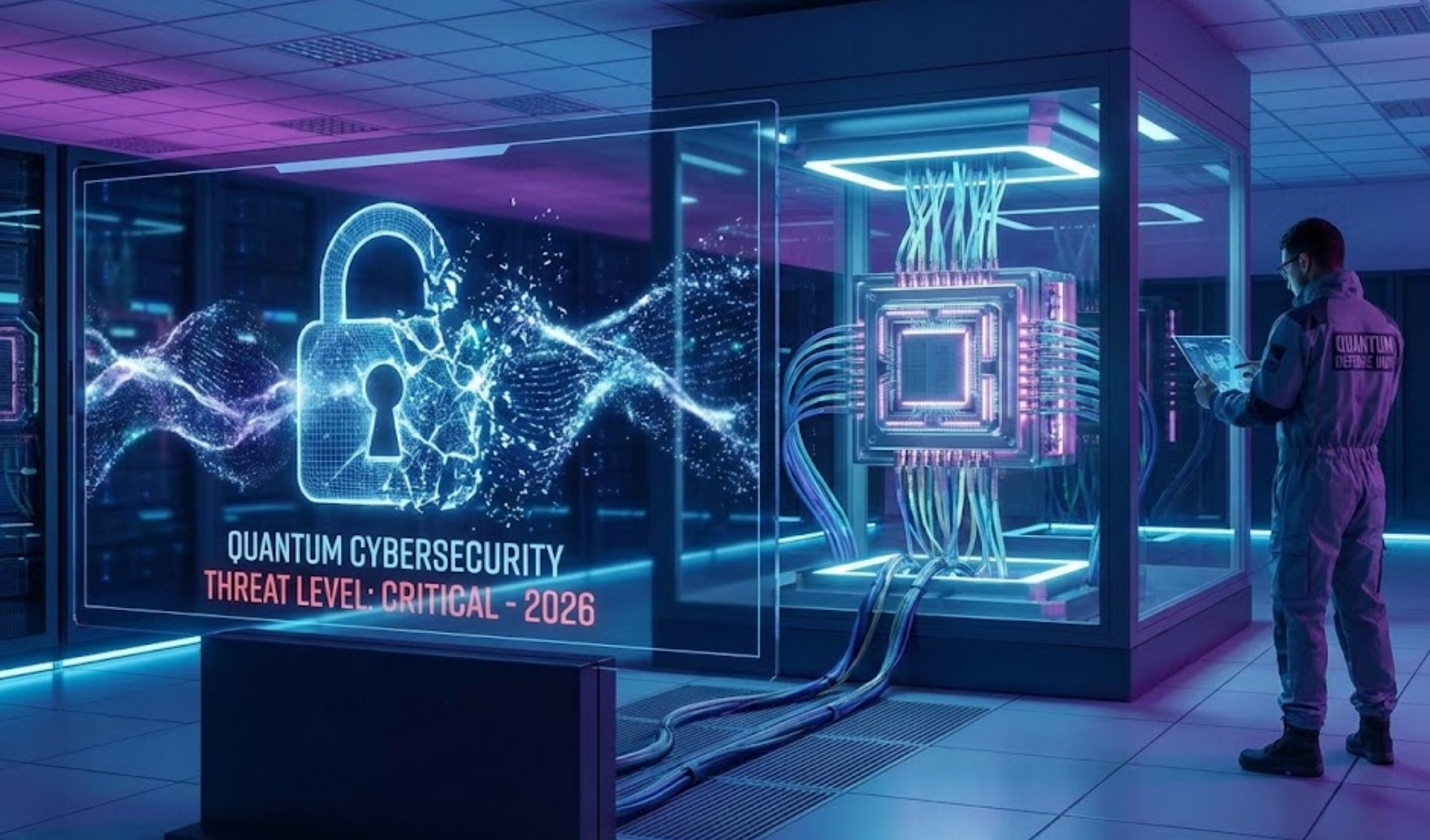
What Makes Quantum Computers Different?
To understand the impact on security, we first have to understand how these machines work. Traditional computers—the ones in your pocket, on your desk, or powering the internet—use “bits.” A bit is like a light switch: it is either 1 (On) or 0 (Off). Every photo you take and every message you send is just a massive string of these ones and zeros.
Quantum computers use “qubits.” Because of a weird law of physics called superposition, a qubit can be a 1, a 0, or both at the same time. Think of it like a spinning coin: while it’s spinning, it isn’t heads or tails; it’s a blur of both. This allows quantum computers to process information in ways that are fundamentally different and exponentially faster for certain types of math.
The Great Encryption Crisis
Most of our current cybersecurity relies on a system called Public Key Infrastructure (PKI). When you see the little padlock icon in your browser, your data is being protected by math problems that are incredibly easy to create but nearly impossible to solve in reverse.
The problem is that a specific mathematical shortcut called “Shor’s Algorithm” exists. A sufficiently powerful quantum computer can use this algorithm to solve those “impossible” math problems almost instantly. By 2026, the progress in quantum hardware has reached a point where the following risks are no longer theoretical:
-
- Financial Records: Banking transactions that rely on traditional encryption could be intercepted and decoded.
- Government Secrets: Classified communications sent years ago could be decrypted, revealing sensitive diplomatic or military information.
- Identity Theft: Digital signatures, which prove you are who you say you are online, could be forged by quantum-powered hackers.
- Blockchain and Crypto: Many cryptocurrencies rely on the very type of math that quantum computers are best at breaking.
The “Harvest Now, Decrypt Later” Strategy
One of the most alarming trends leading into 2026 is something security experts call “Harvest Now, Decrypt Later.” You might wonder why we should care about quantum computers today if they aren’t fully widespread yet. The reason is that hackers and hostile governments are currently stealing and storing encrypted data.
They can’t read it yet, but they are betting on the fact that in a few years, their quantum computers will be powerful enough to unlock it. This means that information you send today—your medical records, private messages, or social security number—might be sitting in a digital warehouse waiting for the “quantum key” to arrive.
Fighting Back: Post-Quantum Cryptography
Fortunately, the cybersecurity world isn’t just sitting around waiting for the “Quantum Apocalypse.” A new field called Post-Quantum Cryptography (PQC) has emerged. The goal is to create new types of locks that even a quantum computer can’t pick.
The transition to these new standards is currently the biggest project in the history of the internet. Here is how organizations are preparing in 2026:
-
- Lattice-Based Cryptography: This involves hiding data inside complex, multi-dimensional geometric shapes. It turns out that while quantum computers are great at factoring numbers, they struggle with these “lattice” problems.
- Quantum Key Distribution (QKD): This uses the laws of physics to send keys. If a hacker tries to “look” at the data while it’s moving, the quantum state of the particles changes, instantly alerting the sender and receiver that the line is compromised.
- Crypto-Agility: Companies are rewriting their software so they can swap out old encryption methods for new ones without having to rebuild their entire system from scratch.
The Road Ahead
As we look at the landscape of 2026, the “Quantum Race” is in full swing. It is a dual-track competition. On one side, scientists are building more powerful quantum processors. On the other side, cybersecurity experts are racing to upgrade the world’s digital infrastructure before those processors fall into the wrong hands.
The impact of quantum computing on cybersecurity is ultimately a reminder of how quickly technology can shift. What was considered “perfect security” five years ago is now becoming obsolete. For the next generation of tech users, staying safe won’t just be about having a strong password; it will be about the invisible math that keeps our digital world from collapsing. We are entering an era where the very physics of the universe are being used to both break and protect our most private information.
