
By the time 2026 rolls around, the world feels faster than ever. Between juggling classes, extracurriculars, side hustles, and a social life that exists both online and off, it is easy to feel like your brain is running too many tabs at once. If you’ve ever felt that late-night panic because you forgot a deadline or realized your digital files are a chaotic mess, you aren’t alone.
The secret to staying calm in this high-speed era isn’t working more hours—it’s having a system that does the heavy lifting for you. Two heavyweights dominate the productivity world: Getting Things Done (GTD) and P.A.R.A. While they might sound like government agencies, they are actually blueprints for organizing your mind and your digital life.
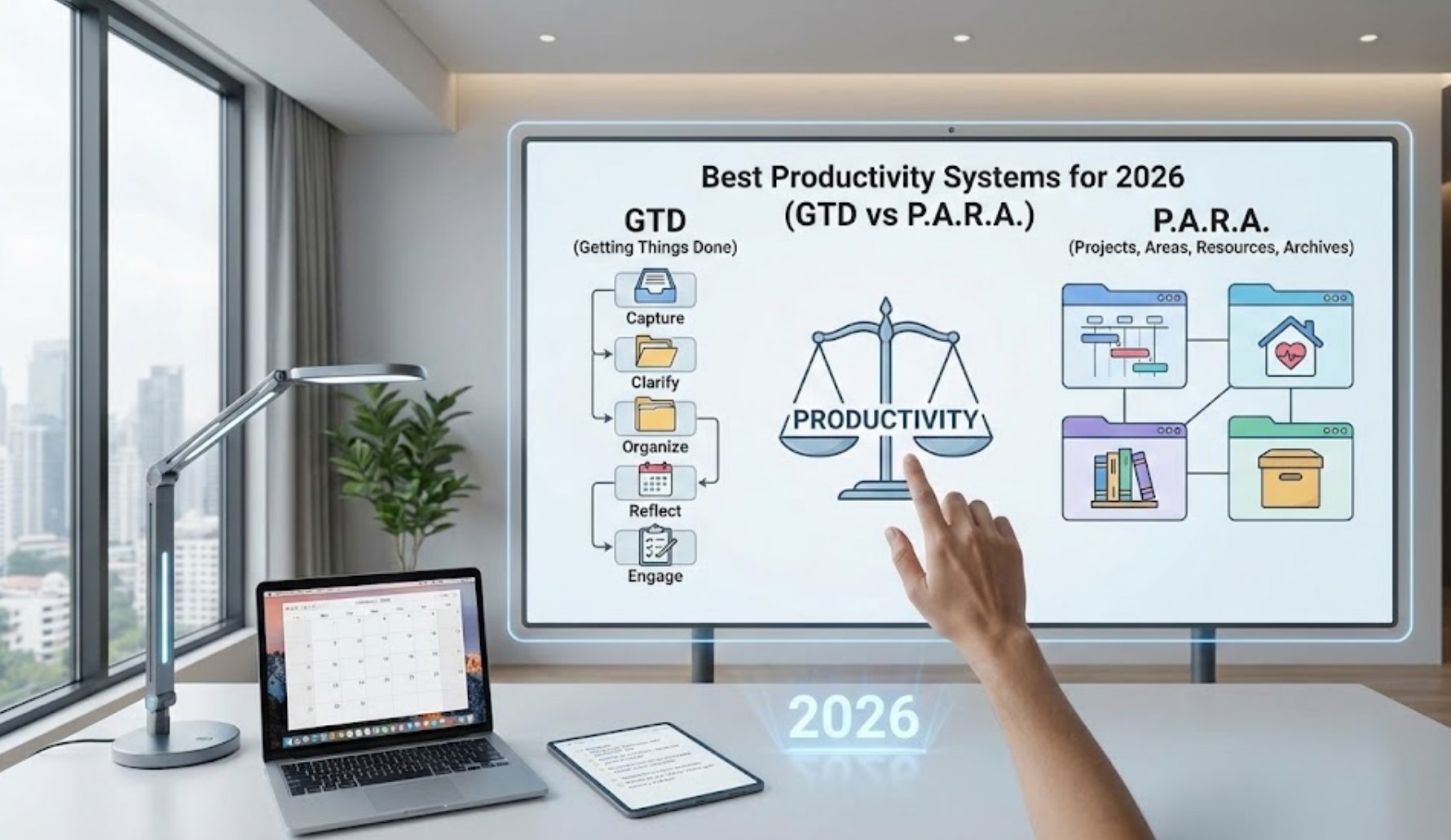
GTD: The Art of Stress-Free Action
Created by David Allen, Getting Things Done (GTD) is the “O.G.” of productivity systems. Its core philosophy is simple: your brain is for having ideas, not for holding them. When you try to remember every little thing—from “buy new pens” to “study for the history midterm”—your mental “RAM” gets used up, leaving you feeling sluggish and stressed.
GTD breaks down productivity into five specific movements:
-
- Capture: Write everything down the second it pops into your head. Use a notes app, a physical journal, or even a voice memo. Don’t filter it; just get it out of your head.
- Clarify: Look at what you captured. Is it actionable? If it takes less than two minutes (like replying to an email), do it right now. If it’s bigger, decide exactly what the next step is.
- Organize: Put these tasks where they belong. A “To-Do” list, a calendar, or a “Waiting For” list.
- Reflect: Once a week, look over your lists. What did you finish? What needs to be moved to next week? This prevents things from falling through the cracks.
- Engage: This is the part where you actually do the work, confident that you are working on the right thing at the right time.
GTD is perfect for people who feel overwhelmed by “to-dos.” It clears the mental fog and ensures you never miss a deadline again.
P.A.R.A.: Organizing Your Digital Universe
While GTD focuses on tasks, Tiago Forte’s P.A.R.A. system focuses on information. We live in an age of information overload. Between PDFs, saved TikTok tutorials, screenshots, and lecture notes, our digital lives are often a graveyard of “I’ll look at this later.”
P.A.R.A. stands for the four categories where you store every piece of information in your life:
-
- Projects: These are things with a deadline. Examples include a science fair project, an essay for English, or planning a birthday party.
- Areas: These are ongoing responsibilities that don’t have an end date but require a high standard. This could be “Fitness,” “Finances,” or “Social Media Presence.”
- Resources: This is your library of interests. If you are learning about photography, coding, or 19th-century fashion, those notes go here. They are things you might want to reference later.
- Archive: This is for everything from the other three categories that is finished or no longer active. Completed a class? Move the whole folder to the Archive.
The beauty of P.A.R.A. is its flexibility. It works across your computer folders, Notion, Google Drive, and even your email. It ensures that when you need to find that one specific note from three months ago, you know exactly where it is.
Which System Should You Choose?
Deciding between these two depends on what your biggest struggle is. To make it easier, consider these scenarios:
Choose GTD if:
-
- You constantly feel “scatterbrained” or forgetful.
- You have a million small tasks and struggle to prioritize them.
- You prefer a linear, step-by-step way of handling your day.
- You want a system that focuses on movement and completion.
Choose P.A.R.A. if:
-
- Your desktop is covered in random files and “Untitled” documents.
- You enjoy collecting research, inspirations, and ideas.
- You are working on multiple big projects that require a lot of different resources.
- You want a system that focuses on structure and retrieval.
The Hybrid Power-Up
In 2026, the most effective people often don’t choose one or the other—they combine them. This is the ultimate “Pro Move.” You use P.A.R.A. to organize your digital workspace (the “where”) and GTD to manage your daily actions (the “how”).
For example, if you are working on a video project for a media class:
-
- In your P.A.R.A. system, you create a folder under Projects called “Media Class Final.” All your clips and scripts go there.
- In your GTD system, you Capture the task “Edit first 30 seconds” and move it to your daily list.
By using both, you create a “Second Brain.” Your actual brain is freed up to be creative, solve problems, and actually enjoy your life. Productivity isn’t about being a robot; it’s about building a system that lets you be more human. Whether you start with a simple GTD list or a clean P.A.R.A. folder structure, the best time to start is today. Your future self will definitely thank you.
